
Updated October 9, 2026. I’ve moved the poll protection actions to a separate article: How to Protect the U.S. Midterm Elections This Fall
Like many of you, I feel disillusioned with electoral politics.
As a social worker, I’ve believed strongly in systems change and held macro-level political advocacy in high regard. The last couple of years have forced me to examine some of my convictions, and how much weight they carry in a time when our world is fundamentally changing.
A while back, someone replied to an email I wrote with a call to action:
We’re not going to vote or call our representatives out of this one.
I understand the sentiment. I’m under no illusion that our current system will resolve the existential problems we’re facing. No politician is going to swoop in and fix all the complex problems in our extractive system riddled with bad incentives.
I don’t believe we’re going back to the way things were (for those of us with various layers of privilege). And I’m not interested in preserving a status quo where the freedoms some of us enjoy are built upon ecological destruction and the exploitation of others.
The converging threats of this moment, including AI, data centers, the climate crisis, inequality, polarization, and autocracy, likely mean that civilization and the systems we know will look very different in the years ahead. For many, of course, they already do.
At the same time, I have concerns about forms of “collapse” discourse that lead people to disengage altogether from the policies that shape our societies.
We need a nuanced view that makes room for multiple strategies—and recognizes how these efforts can reinforce one another to build collective power.
We can acknowledge the profound problems in electoral politics, shaped by powerful interests and incentives, while also recognizing that elections have real material consequences.
Like many on the left, I’m fed up with Democrats and I could give a list of grievances. One of the most glaring examples is that the two parties have not been so different when it comes to sending billions of our tax dollars to fund a nearly three-year genocide in Gaza and expanding occupation in the West Bank. It’s despicable and infuriating.
That also doesn’t mean there are no differences between candidates, parties, or the policies they pursue that impact the rights and day-to-day lives of many others.
While elections and politicians aren’t going to save us, I want the least amount of suffering for my fellow humans and the more-than-human beings.
I want decent, rational adults at the helm. I want to preserve what’s left of our democratic processes and institutional checks. I want those in power to be held accountable. I want us to protect our elections without believing that voting alone will create necessary change.
We Can’t Outsource Change to Politicians
Electing candidates and then sitting back to wait for them to deliver is a recipe for failure.
FD Signifier’s video essay “Why You Can(not) Trust Zohran Mamdani” gets at this in his critique of where the left went wrong with Barack Obama.
To be clear, he’s not arguing against Mamdani and his point is not about Obama or Mamdani. It’s about what happens when a left-leaning, maybe well-intentioned politician actually gains governing power in our current system.
The video is eight months old now. It should be noted that Mamdani’s team has since delivered on multiple campaign promises. Although the fact that he is somehow repeatedly praised by the megalomaniac running the U.S. should keep populists on their toes.
No politician should be treated as a savior, or a stand-in for sustained organizing and accountability.
We Can’t Outsource the Work to Others
I recently heard a replay of a Movement Memos podcast, in which organizer and abolitionist Mariame Kaba referred to the “conciergification of activism”. The term describes the convenience of frictionless apps and on-demand services has seeped into political spaces, creating a consumerist identity when it comes to action.
That is, instead of doing the longer, messier work of organizing, building relationships, direct action, and advocacy, it’s easier to sign a one-click petition, post on social media, or assume others will do the work of justice and liberation.
None of these are a substitute for what’s needed for structural change. That doesn’t mean those actions are meaningless, but we need to ask how they connect to broader efforts to organize and build collective power.
Let’s Hold More Than One Thing and Practice Our Values
We can be put off by electoral politics without abandoning democratic processes. The status quo was never just or liberatory, but that doesn’t mean everything standing should be dismantled. We need to protect large-scale safety nets that materially sustain people while simultaneously imagining and building new ones.
And there’s room to practice different values now, in localized places:
- Mutual care over competition and hyperindividualism
- “Enough” over consumption that feeds endless growth
- Sharing resources instead of having our own “everything”
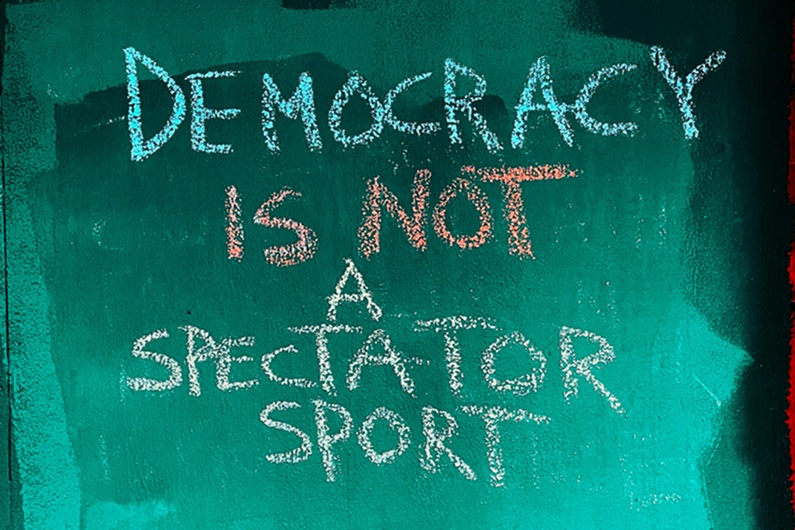
- Participation in change work instead of spectatorship
- Collective decision-making over unilateral decisions
I don’t know what the future holds. I do know that the world we want won’t appear formed when these systems change. We’ll have to build it together, and we can start practicing now.
Building Power Beyond Election Cycles
Elections are one of the few moments when large numbers of people are paying attention and looking for a way to get involved. That makes them a rare, low-barrier opportunity to practice the kind of organizing we’ll need no matter what happens in November.
Regardless of our political trajectory, there are ways to engage during election cycles that grow relationships and capacity we can carry forward.
Democratic participation builds civic capacity.
Understanding and upholding democratic processes at scale can better equip us to organize our block or building.
Campaigns build relationships.
Campaign work brings people together across class, race, and generation. These cross-group relationships are what movements are built on.
Canvassing builds knowledge of our communities.
Door-knocking may be about sharing information, but it also opens up conversations with our neighbors. We may learn who’s isolated, who’s an ally, or who has resources.
Canvassing is not my favorite activity. But building courage and learning to tolerate discomfort, builds the resilience we need right now.
Organizing builds capacity.
When we organize campaigns or volunteers, we’re building the same muscles we’ll need to organize a rent strike, mutual aid network, or other collective action.
Collective protection builds systems of care.
Whether we’re protecting voters or our neighbors from ICE, we’re creating systems of care to look out for each other.
Overlapping networks make communities more resilient.
Political work can overlap with mutual aid networks. Those relationships can outlast any single campaign and give us more capacity to respond to challenges in our communities
None of this requires believing that elections will save us. And we don’t have to agree on everything to work together on something. It invites us to use this season to build the relationships and capacities that can actually move things.
What’s before us right now is rampant voter suppression, and protecting our elections is critical.
For concrete actions to help protect the polls, read:
How to Protect the U.S. Midterm Elections This Fall

Your thoughts here are inspiring Melissa! Thank you!
I’m glad to hear they were helpful, Tom!